
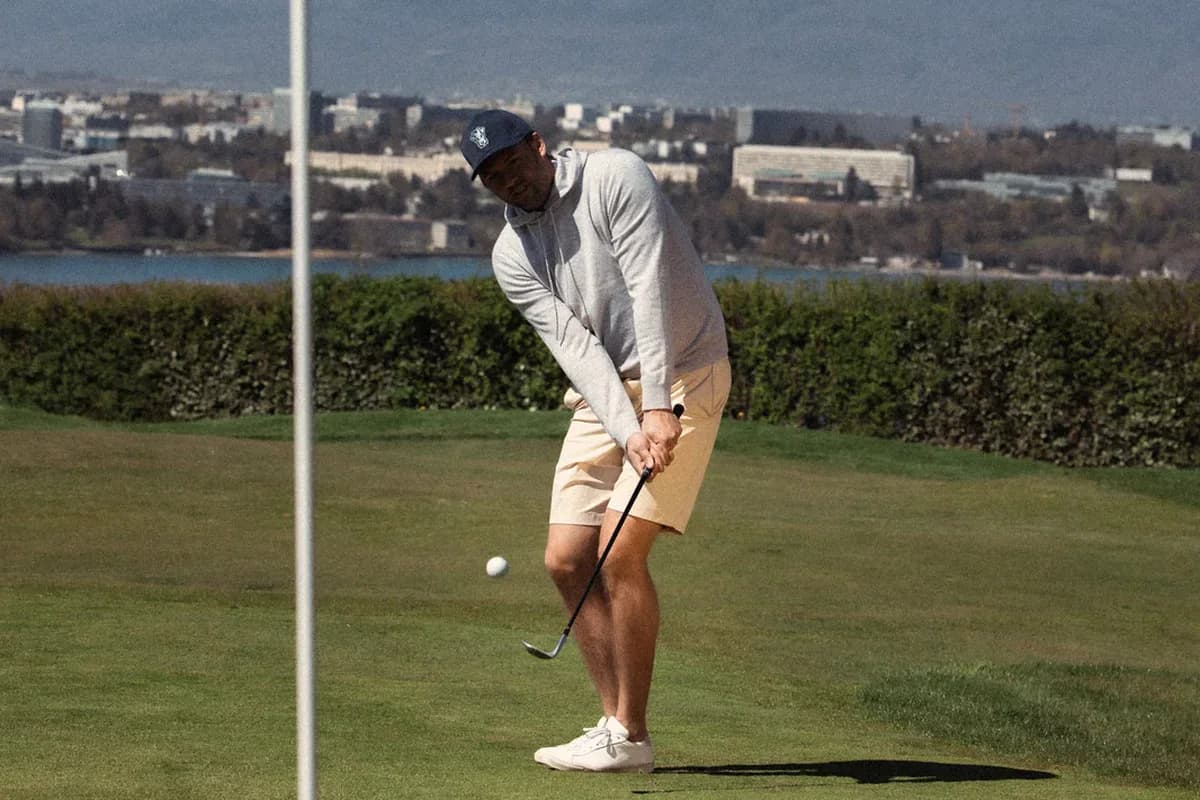
The opposite slope is still in shadow when you hit your first drive, fingers cold. Three holes later the sun has cleared the ridge and you are playing with your sleeves pushed up. On the 14th the little valley tips back into shade, the wind comes up, and you close everything again.
Dressing for mountain golf fits in one sentence: thin layers you open and close as you walk, a collar you can close when the wind comes up, and enough cover from the sun even when the air is cool. The rest is comfort.
At altitude, when the day does not have the same range
Here, we go up to the high courses in summer, on the day it is too hot down below. You leave a valley in the morning and come back down in the evening having played a different season.
At altitude a day can move in steps: the tee in the shadow of the slope, full sun on the open holes, then a little valley that tips back into shade. On top of the morning cold, those changes of exposure. The outfit has to follow both, without becoming a burden the moment the sun returns.
The layering principle does not change with altitude. What an adjustable collar gives you is the ability to adapt from one hole to the next. You open or close it as you walk; you keep the change of layer for the bigger swings.
If you remember one thing: in the mountains, look at the temperature, the wind and the exposure. We would dress for the forecast at the course, with a warm layer available in the bag. The adjustable collar fine-tunes comfort; it does not replace that reserve.
Shorts or trousers: choose according to the forecast temperatures and how you feel the cold. A warm layer on top will not warm your legs.
The wind, which arrives without warning
The wind can change abruptly as you pass a slope or a ridge. One hole sheltered, the next one straight into it: sometimes you feel it before you have seen a tree move.
Two consequences. The first: a high collar, closed, limits how much air gets in at the neck. It is a one-second adjustment, without opening the bag, as long as the wind stays moderate.
The second: nothing should flap. A loose panel, a hood beating against your back, moves at exactly the moment you should be thinking about nothing. The cap too, set tight before you tee off.
And if the slope really blows, you need a proper windproof. We do not make one. Like the rain jacket, it will come from somewhere else, and that is fine.
The sun, sharper than down below
You can have cold hands on the tee and come home with a red neck the same day. Cool skin tells you nothing about UV. Clouds absorb some of it, but a light veil can leave the radiation high.
As you climb, the atmosphere filters less ultraviolet: according to MeteoSwiss, the radiation increases on average by ten to twelve per cent per thousand metres. A round lasts several hours, sometimes across the middle of the day, when UV is strongest. Altitude and duration add up: cool air does not excuse you from protection.
The places that catch it are always the same: the forehead, the ears, the back of the neck, the top of the forearms.
Long sleeves cover the forearms; how much they protect depends on the fabric. The Swiss Cancer League recommends shade, clothing, a hat and sunglasses, with sunscreen as a complement, reapplied regularly. On a course, that also means taking the shaded pauses when they come.
A cap leaves the ears and the back of the neck exposed. A wide-brimmed hat covers them better; think about cream on the skin that stays uncovered.
Better to prepare that protection on the tee than to rely on feeling warm to remember it.
What goes with you, what stays in the car
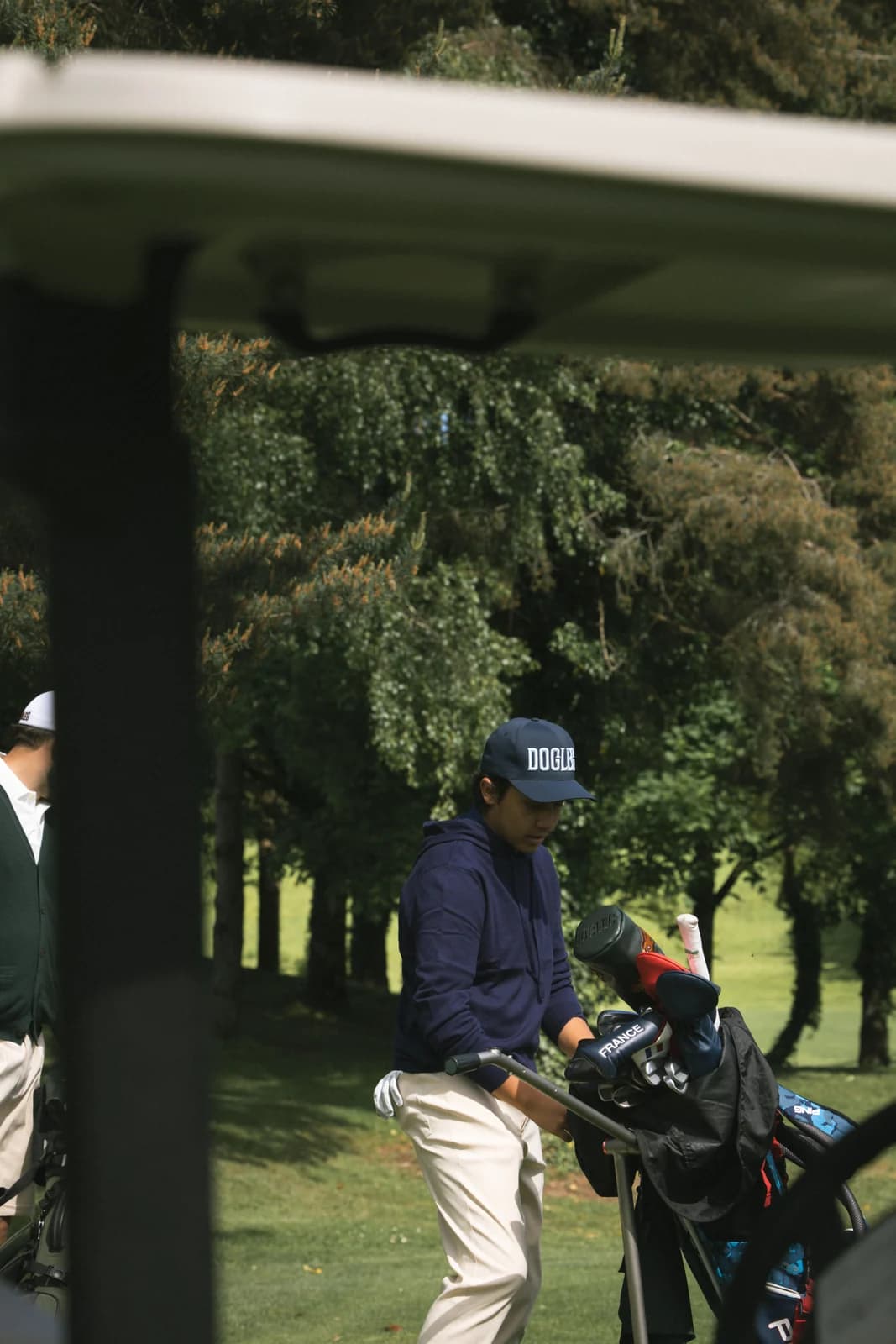
In the bag, on top of what you usually carry: a warm layer and whatever protection the forecast wind or rain calls for. The collared layer stays useful under a blue sky, at the moment you walk into shade. And something to protect the neck and the forearms. On that we do not compromise.
In the boot, leave a dry top for the drive home. The layer you might need out on the course stays in the bag: the car can be a long way off when the weather turns.
People often say things are more relaxed in the mountains. Altitude still does not excuse you from checking what the club asks for. The weather adds its requirements to those of the dress code; it does not replace them. A collared top, a bottom suited to the course and clean shoes make the base.
The quarter zip
The quarter zip is the piece we would recommend for this kind of alternation. Collar closed on a tee in the shadow of the slope, open as soon as the sun clears the ridge: you can usually adjust it without needing to take it off.
Ours is not a windproof and does not pretend to be: it is a mid layer, to be completed according to the weather.