
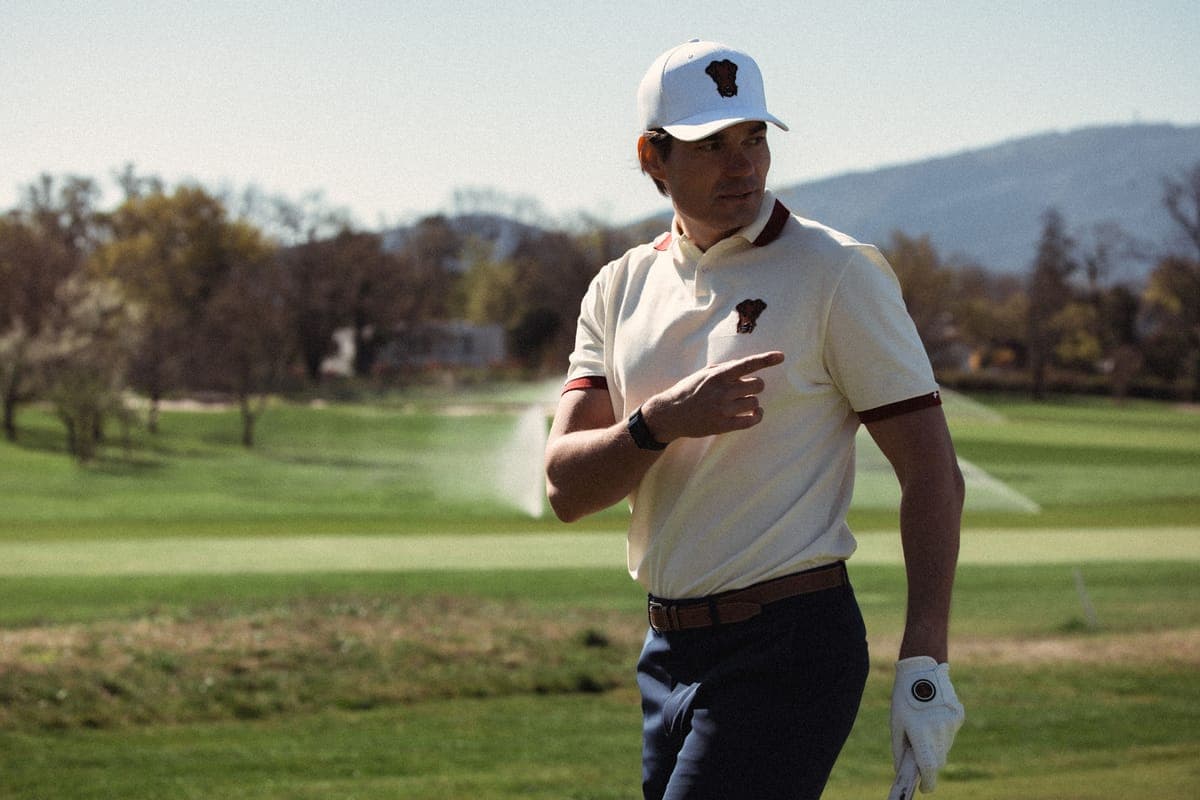
You know the gesture: the hand going round the back to tuck the polo into the trousers, between two shots, without even thinking about it. We do it constantly, and for a long time we believed it was a question of size, that we should buy something longer.
It is almost never the size. It is how the garment is built, and you can check it in the fitting room, in two movements, with nothing but your arms. The rest — the trademarked technologies printed on the label — is vocabulary.
Try it moving, or you aren’t trying it at all
You wear a golf polo for hours, during which your arms go above your shoulders, your torso turns, your back opens, with a bag on your shoulder. Trying it on with your arms by your sides in front of a mirror tells you nothing about any of that.
Two movements are enough. Raise both arms to the horizontal, then mime a backswing, slowly, without worrying about the mirror. If the hem rides up, or if the fabric pulls across the top of the back, the cut is the problem. Not the size. And no amount of washing will change a thing.
A second marker, quicker still: bent forward in the fitting room, your back must stay covered — so the back must be slightly longer than the front.
One sentence on dress codes and we move on: a collared top passes everywhere, jeans stay in the locker room on the course even if some clubhouses tolerate a clean pair, metal spikes are out where soft spikes are fine, the cap comes off indoors, and since it all varies from club to club, a call to the office settles the rest.
The armhole, and if you remember one thing
The armhole is the opening the sleeve is sewn into. Nobody mentions it in a shop, and it is nevertheless the thing that decides everything.
When it is cut low and wide, the seam sits far below the armpit, and raising your arm moves more than the sleeve: it drags the whole body of the garment upwards. The hem comes out of the trousers, the fabric tightens across the back, and you spend your round readjusting. A higher, narrower armhole, with the shoulder seam landing exactly on the bone, lets the arm rise without taking the rest with it.
It is counter-intuitive, we know: in the fitting room a roomy polo feels like it offers more freedom, and the opposite is true. If you remember one thing from this article, remember that one.
The fabric: what matters is the recovery
Far too much is made of stretch: any fabric stretches. What matters is the recovery. Pull a panel of fabric firmly across its width, then let go: if a visible deformation remains, you already know what the elbows and the small of the back will look like a few rounds from now.
On a playing polo, that recovery comes from a share of elastane blended into the polyester. It is what makes a garment settle back into shape instead of staying stretched at the elbow.
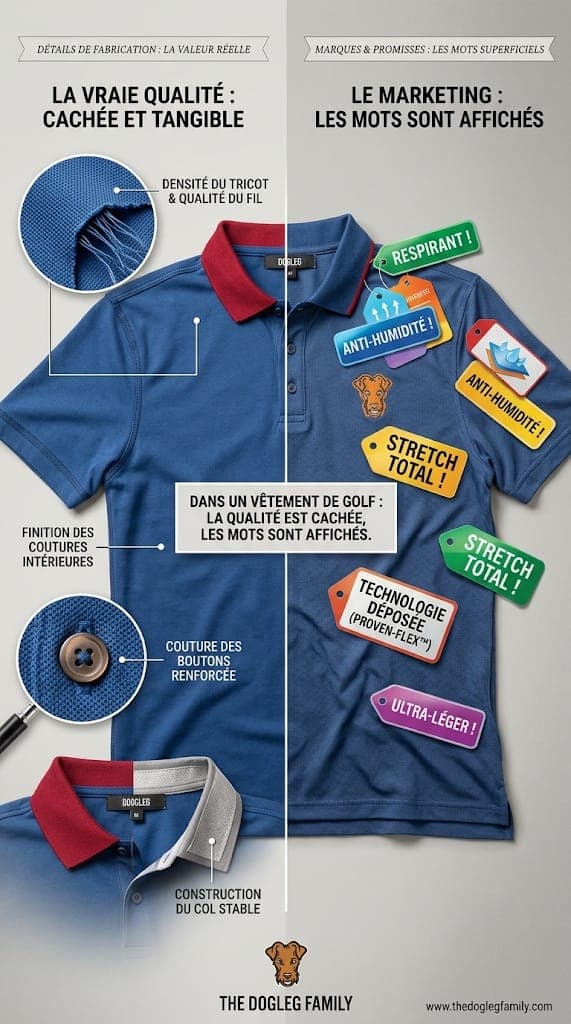
Turn the garment inside out: regularity of the knit, cleanliness of the inner seams. Be wary of anything very soft under the fingers: it tells you nothing about what comes next.
The collar: one test, and nothing else
A collar that ripples can be seen from a distance and cannot be rescued. You won’t find out in the fitting room how it was constructed, and you don’t need to: the test takes three seconds.
Fold the collar down, firmly, then let go. It must come back on its own, without keeping the crease. Then look at the button placket: flat, crisp, cleanly sewn. A placket that is already twisting on the hanger will not straighten out at home.
Care, which counts as much as the choice
Cold machine wash, dark colours washed separately, no bleach, and above all no fabric softener: it leaves a film on the fibre and makes it lose exactly what you bought it for.
For children, same tests, but on the child, not on the hanger: a kid will never tell you their polo is in the way, they adapt their movement without realising it.
What to remember
- Arms up and a mimed backswing in the fitting room: a polo that rides up there will ride up on the course.
- The high armhole before anything else. Wide does not mean free.
- On fabric, it is the recovery after stretching that counts, never the softness.
- The collar is folded and must come back on its own.
- No fabric softener, ever.
We designed our polos starting from these questions, because we couldn’t find what we wanted to wear. Put them through exactly the same tests as the others, slow backswing included.