
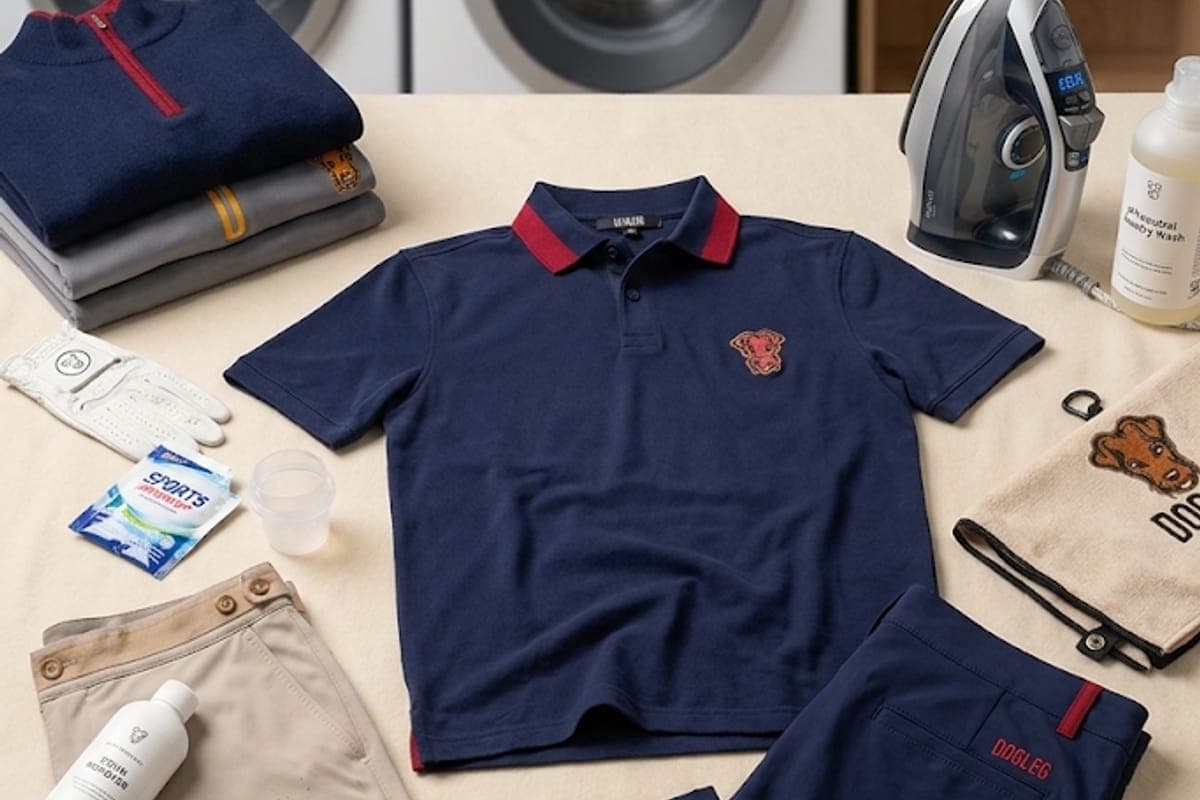
Look at the polo you wear most often, the one you grab without thinking on a Saturday morning. There is a good chance it is also the most tired garment in your wardrobe. And the course is not what put it in that state.
Golf clothing wears very little outdoors. It wears out in the machine, in the tumble dryer, and during the months it spends waiting for the season to open. Two culprits: heat and residue.
What the label says, and the label is right
Across our whole technical range the label says the same thing, and it is short: cold machine wash, 30 °C symbol, dark colours washed separately, no bleach, no fabric softener, low-temperature tumble drying provided the garment comes out immediately, low-temperature iron if you really insist.
Why that protocol and not another? These pieces are polyester with a share of elastane, around 6 to 12 % depending on the model. The polyester moves moisture outwards, the elastane brings the fabric back into shape after every swing. Heat and chemical deposits attack exactly those two things. That is the whole subject.
Washing: heat, always
Synthetic fibres are thermoplastic. Past a certain threshold they deform for good — and that is precisely the principle used in factories to set a crease into a pair of trousers. Water that is too hot therefore sets your unwanted creases, rounds the edges of the fibres and robs the elastane of its recovery. The rippling collar, the knees that stay domed even once the trousers are laid flat on the bed: that is a wash that ran too hot, rarely the age of the garment. A second, less known reason to wash cold: hot water coagulates the proteins in sweat. Once cooked into the fibre, they never come out.
Three habits, every wash. Turn the garment inside out: the drum then rubs against the reverse, and pilling forms where nobody sees it. Close zips and hook-and-loop fasteners: an open metal tooth is a file spinning against the neighbouring knit for the whole cycle. Don’t overload the drum, it washes badly and rubs a great deal. The first one we do systematically. The second gets forgotten every other time, and it shows on the sleeves.
Fabric softener, never
If you remember one thing, take this one. And it is not one opinion against another: it is written on the label.
Fabric softener does not work inside the fibre, it sits on top of it. The film it leaves on the surface is what gives cotton its softness. On a technical fabric, that same film blocks the channels meant to move moisture away. You cannot see it in the wardrobe. You feel it while playing, and always at the worst moment: the polo sticks to your back instead of drying on you. And since that film also holds the skin oils that odour-causing bacteria feed on, the garment comes out of the machine clean and smells of sweat a few holes later.
Too much detergent does the same thing: the excess does not rinse out and behaves like a softener. A reduced dose is enough, nobody will see the difference. Liquid detergent rather than powder, which dissolves badly in cold water.
Spinning and drying
A very fast spin presses the textile against the drum wall under high pressure: sharp creases, elastics and seams tired out for nothing. Keep it moderate, these fabrics dry quickly on their own.
Take the washing out straight away. A polo left in a heap at the bottom of the drum until the next day takes creases that set, and the smell comes back with them. The label allows low-temperature tumble drying, on condition the garment comes out as soon as the cycle ends. We do without it: a dryer combines heat and abrasion, and the lint you pull out of the filter is not dust, it is material torn off your clothes. Air drying then, in the shade, because direct sun damages the fibre and fades it, hitting the shoulders first. Heavy knits are laid flat: on a hanger they stretch under their own weight.
Mud, grass, sunscreen
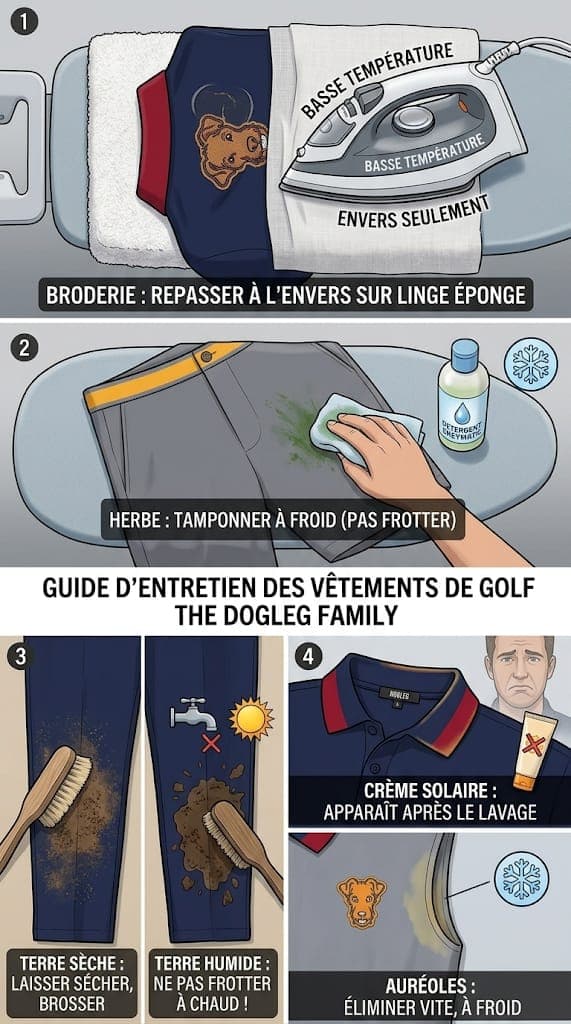
Mud: let it dry. Rubbing wet mud drives the mineral pigments into the heart of the fibre. Dry, mud loses its cohesion: a soft brush removes most of it and the machine does the rest. It is the one case where doing nothing is the right answer, and the one where everybody does the opposite, at the club tap, ten minutes after the shot.
Grass: cold, without rubbing. A grass stain mixes plant pigments and sugars; it behaves like a dye. Blot, don’t rub: rubbing a knit abrades it and drives the pigment in. Pre-treat with an enzyme detergent, let it work, wash cold. Hot water from the start, and the stain is there forever.
Sunscreen: the stain that arrives late. Chemical UV filters can react with the iron in water and leave an orange-yellow mark. It often appears after the wash, on a collar that looked perfectly clean when you came off the course. Let the cream dry on your skin before getting dressed.
Storage, where garments die for good
Never store an unwashed garment, even one that looks clean. The invisible residues — sugars, salts, sebum — oxidise slowly and come back in spring as yellow stains that are often permanent. They also attract moths, which happily attack a stained synthetic fibre.
Store it dry: seams and collars stay damp longer than the rest. Fold knits rather than hanging them for months, otherwise the hanger leaves two shoulder marks and stretches the neckline. A cotton garment bag beats a plastic one, which manufactures mould. Somewhere dry, dark and temperate: neither a damp cellar nor an overheated attic.
That’s it
Wash cold, forget the softener, dry in the shade, store clean. The rest is detail, and you can get it wrong without consequence.