
You can play perfectly well without one. There are players who never wear a glove and strike the ball better than most of us. But the question comes up as soon as someone starts, and it never comes alone: which hand, how tight, do you take it off on the green, and why is that one already finished when it looks almost new.
A golf glove is a thin glove, worn on one hand, that makes the connection between your hand and the club’s grip. It stops the club turning at impact and it protects the skin from friction. So much for the definition. The rest comes down to four or five points, only one of which really counts, and we will tell you which one below.
What it does, and the days it does nothing
A dry grip in a dry hand holds on its own. Very well, in fact. There are late-summer days when the glove brings you strictly nothing, and nobody feels guilty leaving it in the bag.
Moisture is what changes everything. Dew on the first hole when you go out early, the shower that catches you at the turn, or simply the sweat of a heavy afternoon. The hand starts moving inside the grip, and you feel it at exactly the moment you would rather be thinking about nothing.
Then there is stability. If the hand loosens at impact, the clubface rotates a little and the ball goes elsewhere. With a glove, you hold firmly without having to squeeze. Holding without squeezing is already a great deal.
And the skin. Blisters turn up at the start of the season, or on the range on days when you hit one bucket more than planned because it is finally starting to work.
Which hand
The top hand, the one closest to the end of the grip. Right-hander: left hand. Left-hander: right hand. That hand controls the club, the other one goes along with it.
One glove is enough. You come across players wearing two; we have never understood what they gain by it, but if it suits them, so much the better.
On the green
Almost everyone takes it off. Putting is played on feel, you are trying to sense the ball leaving the face, and the material, however thin, puts a little distance between the hand and the grip.
Honestly, on this point, do as you like. Nothing obliges you. The gesture has mostly become a reflex: glove off as you step onto the green, slipped half out of the back pocket, retrieved at the next tee.
How it should fit
Tight. Tighter than a town glove, tighter than seems reasonable when you try it on. A new glove can feel a little snug over the first holes while it moulds to the hand. That is normal, and rather a good sign.
Hand open, no crease in the palm. Every crease is a place where the material moves independently of the skin, and that is precisely where blisters are born. The fingertips must reach the end of their pockets, with no empty space.
The wrist closure fine-tunes the hold, it does not rescue a size that is too big. A glove that is too big will never shrink, and you will spend the season tightening the strap between shots telling yourself it will be fine.
Drying, and this is where it is all decided
If you remember one thing from this article, this is it.
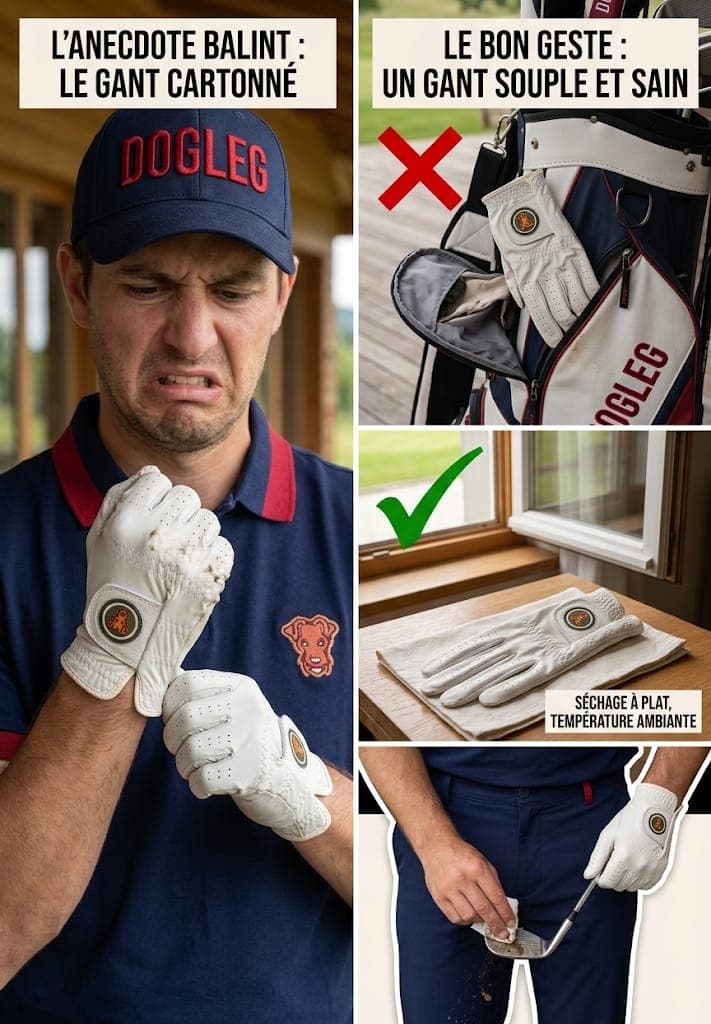
Most gloves do not die of wear. They die at the bottom of a bag. You finish your round, take off a damp glove, roll it into a ball in the side pocket and think about something else. The following week you find it shaped like a fist, stiff, creased into a shape that is not your hand’s. You can massage it, stretch it, put it on anyway: it will not go supple again. It is finished, and it still had most of its life ahead of it.
The remedy takes a few seconds. When you get home, take the glove out of the bag and let it dry flat, at room temperature, away from any direct heat source. Not on a radiator, not behind a windscreen in full sun.
The rest is common sense. Two gloves in rotation last longer than two gloves worn out one after the other. And a glove is not a towel: on the day you have nothing to wipe a mud-caked iron with, use the grass, use your trousers, use whatever you like, but not the palm.
When it is finished
The palm goes smooth and shiny where the contact happens, the material is polished and no longer grips. The glove floats on the hand. A hole appears at the base of the thumb. The material hardens and cracks.
It brings nothing more to the hold. You keep it in the bag a while anyway, like everyone else, then you end up throwing it out.
What to remember
- Top hand: left for a right-hander, right for a left-hander. One is enough.
- Tight, with no crease in the palm. Too big is lost from the start.
- The green, however you feel about it.
- Dry it flat after every round. Everything else is secondary.