
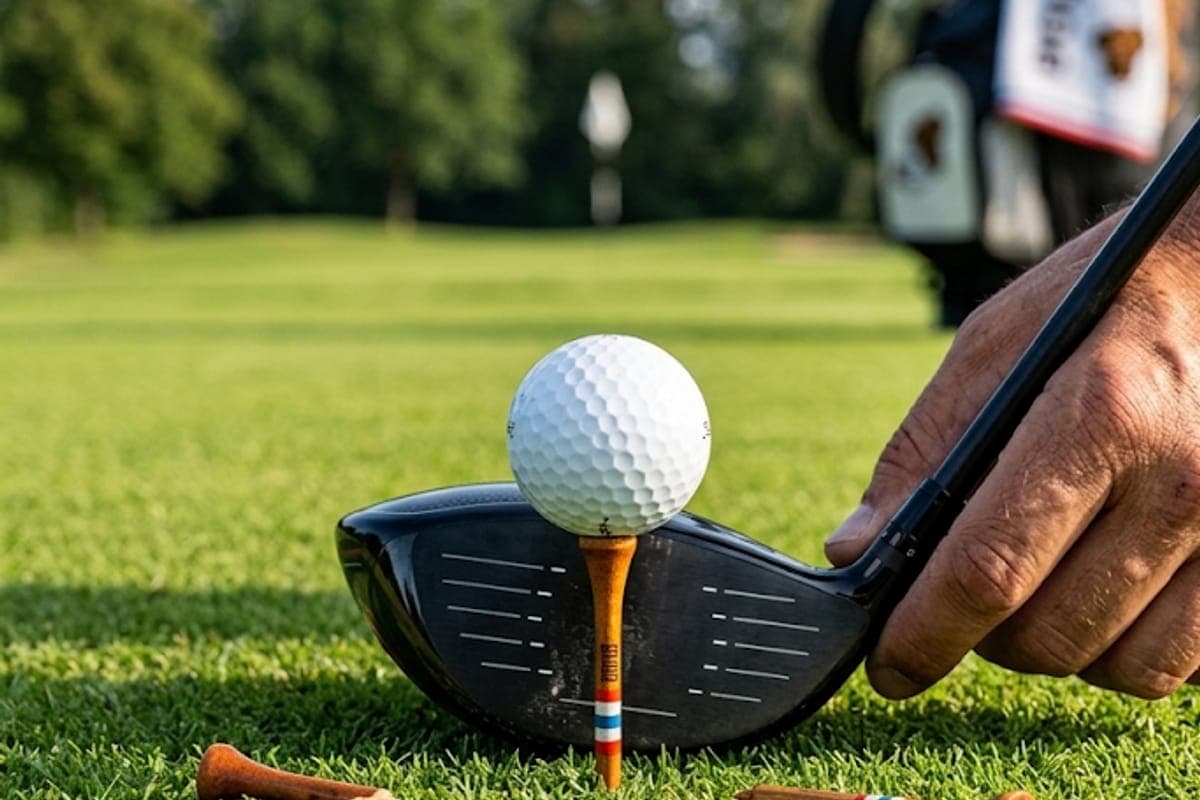
There is that moment, on the tee of a long hole, when you look at your bag and pretend to hesitate. The big club sticks out above the others. You know perfectly well that in ten seconds you are going to take it. So do we.
Right. The driver is the longest club in the bag, the one with the largest head and the least angled face. It is there to send the ball a long way from the tee. It does nothing else, and that is already plenty.
One thing, very well
Its length gives a wider swing arc, so more speed at impact. Its almost straight face sends the ball low and far, with little backspin. The head is wide, the impact area generous, and it forgives off-centre strikes a little.
A little. People happily repeat that this big head is forgiving, and that isn’t wrong, except that the length of the shaft takes back with one hand what the volume gives with the other. If you remember one thing, it is this: the driver mainly forgives those who already strike it well.
Whether to pull it out
On the tee of a long hole, when the ground in front of you allows it. Ball on a tee, slightly raised, struck on the way up. So much for the theory.
Everywhere else, it stays in the bag. Except that “everywhere else” covers a great many tees where you are going to pull it out anyway. Short hole: an iron or a hybrid places the ball better, everyone knows it, almost nobody does it. Narrow tee shot lined with trees or water: the shorter club costs you distance and keeps you in play, and you will promptly be told that you could have gone for it. It is generally the person in the trees who tells you.
Honestly, on this point, do as you like. We play with people who put the driver away as soon as a tee shot tightens and who return very good cards, and with others who take it every time and enjoy themselves considerably more. What irritates us is the lecture explaining to an amateur what he “should” be doing with his bag on a Sunday.
Why it is hard
Everything that makes it powerful complicates its control. The longer the shaft, the further the head travels, the more a small error of path is amplified. The almost straight face does not help: the ball is less stabilised by its spin, so sideways deviations show up more.
And you have to take a ball out of the air, at the end of the movement, without touching the ground first. Many players strike their irons cleanly for years before feeling at ease with this club. There is nothing abnormal about that.
What really damages it
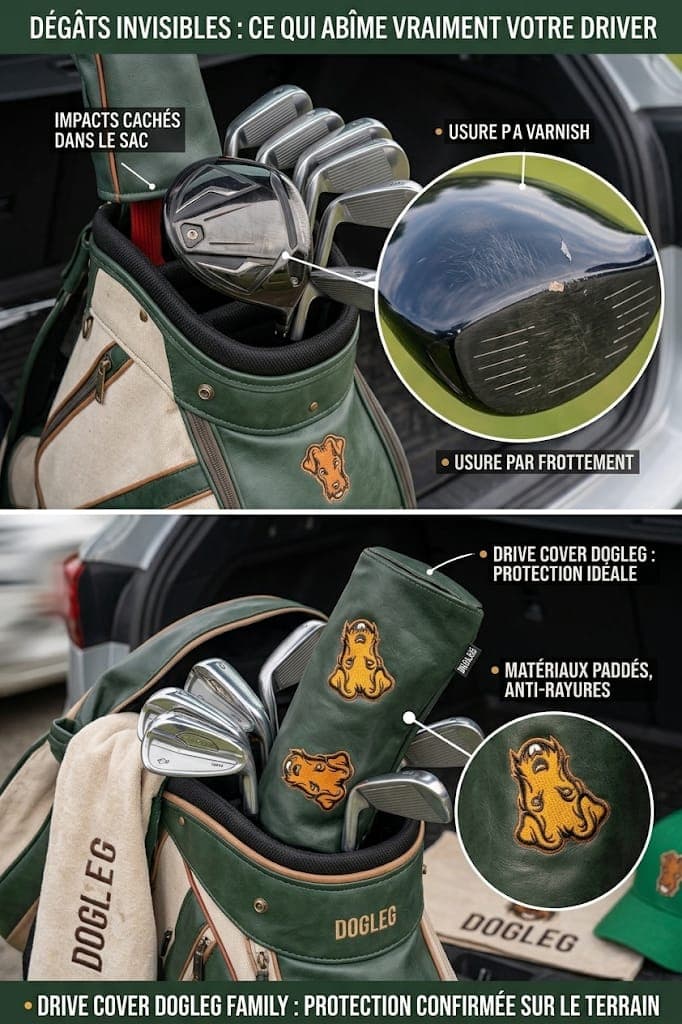
The head is thin and hollow. It is rarely damaged while playing. Everything happens in the bag.
Clubs standing in the same compartment end up knocking into each other. At every step, at every buggy turn, at the moment you lift the bag out of the boot and everything settles back with a clatter of metal. The driver sticks out, so the driver takes it. The crown gets scratched. The face chips. The varnish comes off in small patches.
The trouble is that it happens slowly enough never to be noticed. You put the club down, you pick it up again, you see nothing. Then one day you hand it to someone who replies “ah yes, that one has been around”.
Hence the headcover: a sleeve that stays on the head during the round and comes off when it is time to play. It is not a sophisticated object and there is no reason for it to be. The only real risk is leaving it behind on the tee, and against that there is no equipment, only habits.
To remember
- The driver is made for distance, and for nothing else.
- It comes out on the tee of long holes, not systematically, and the rest is a matter of taste.
- Its length and its straight face amplify errors: it is the most demanding club in the bag.
- It gets damaged in the bag, not on the course.