

Your ball is on the green, three metres from the hole, and squarely on the line of the player putting before you. He will say nothing. He will wait, looking at you. That is about the only moment of the day when the smallest object in the bag becomes the most important.
A ball marker is that flat disc you place behind your ball before lifting it, so you can put it back exactly where it was. That is all. Its entire job is to make sure nothing moves.
And it matters, because a position on a green is played to the centimetre. Nobody finds that centimetre again from memory, especially after crouching all the way round the green to read the line and coming back from the other side.
The sequence
Four steps, always in the same order. You place the marker behind the ball, on the side away from the hole. You lift the ball, you clean it if it needs cleaning. You set it back down in front of the marker, touching it, where it came from. You lift the marker, you play.
If you remember one thing, it is the order. The marker goes down before the ball is touched, never after. A ball lifted first and marked afterwards is no longer marked: it is put back roughly, which is not the same thing. It is the mistake we see most often, and it is always made in good faith. The player picks up, remembers, then puts the disc where he believes it was.
The other case comes up constantly: it is your marker that is in someone’s way. You move it one or two putter-heads across, taking a fixed reference on the green, and you retrace that path before playing. The “before playing” is the part everyone forgets.
You do not need to know the text of the rules by heart to do this properly. It all comes down to two movements: the disc goes behind the ball before the ball is lifted, and the ball comes back to the same place, not next to it. Do that and you have done the main thing. For the awkward cases, the ones that come up once a season, you ask your playing partner before touching anything. We have never seen anyone get a bad reception for asking. We have, on the other hand, seen plenty of people settle it quietly on their own and then spend the whole next hole wondering whether they got it right.
Nobody will say anything to you
Marking your ball is in the rules, but in practice it is first of all a courtesy. It is a silent way of telling the other three: I am not on your line, go ahead, play. The green is the place on the course where you are closest to one another, where the slightest gesture is visible, and where the person rummaging in his bag while three people wait can feel it. Nobody will remark on it. That is precisely the problem.
Because the remark never comes. It turns into a slightly long silence, a glance towards the flag, and the person who took twenty seconds to find his marker takes two holes to work out why the mood changed. A marker you can produce in one second solves that problem before it exists.
The real subject: you are going to lose it
The rest you learn in one round. This you don’t. It is flat, it is tiny, it makes no sound when it falls, and it has a capacity for disappearing that bears no relation to its size.
The three classics: left on the bag while you have a drink, slipped out of your pocket as you sit down, or left on the ground on the green of the hole you have just walked off, because you holed a putt and left happy. That one you never find again. You notice two greens later, when you put your hand in your pocket and there is nothing in it.
Only one thing really works: give it a place, and always the same one. A specific pocket, the magnet on your pitch-mark repair tool, the peak of your cap. The magnet on the peak has never worked for us, because you take your cap off to wipe your forehead twice a hole and the disc ends up in the grass. But honestly, on this point, do as you like. What counts is not the place, it is that it never changes. The day you put it “just here for now”, it is over.
The second habit is keeping a spare at the bottom of the bag. The one you never take out as long as the other is there. It looks like an obsessive’s detail, and that is exactly why it works.
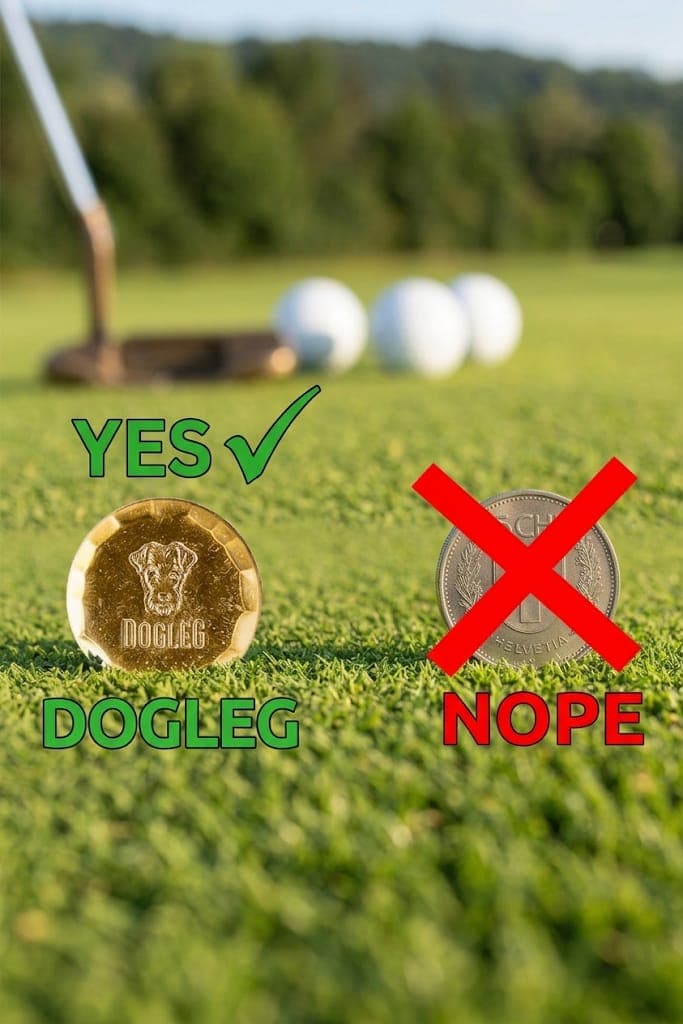
And yes, a coin does the job. We have nothing against it, we have used them. It is simply thicker, it rolls as soon as the green tilts a little, and you end up spending it without thinking. A real ball marker has one silly advantage: it is good for nothing else, so it stays where you put it.